
Industrial Minerals → Walnut Shell
Iranian Walnut Shell: Properties, Uses, Specifications and Export Guide
Introduction
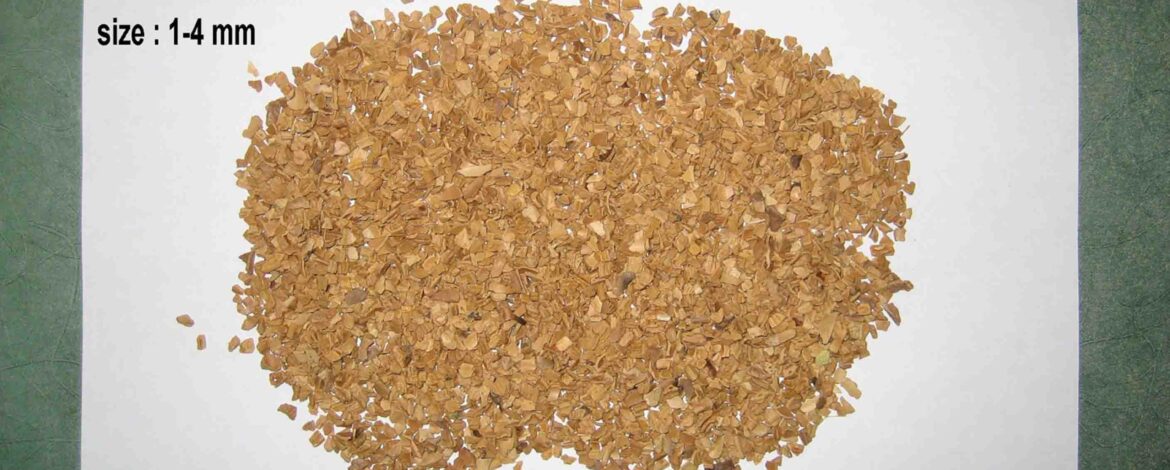
Iranian walnut shell is a natural agricultural by-product obtained from walnut processing. After appropriate cleaning, drying, crushing, grinding, and classification, walnut shell can be converted into a valuable industrial material for applications such as abrasive blasting, oil and gas drilling, filtration, cleaning, polishing, composite materials, and other specialized processes.
Walnut shell is particularly attractive for industrial applications because it is a natural, relatively lightweight, hard, and biodegradable material. It can be processed into different particle sizes ranging from coarse granules to fine powder according to the requirements of the end user.
Iran is one of the important producers of walnuts and has access to substantial quantities of walnut shell as a by-product of walnut processing. This provides an opportunity to supply processed walnut shell to international industrial markets.
The quality of walnut shell depends on the walnut source, cleaning process, moisture content, hardness, particle-size distribution, foreign-matter content, and processing method.
This guide explains what walnut shell is, its properties, major industrial applications, particle sizes, quality requirements, packaging, storage, pricing factors, and export considerations.
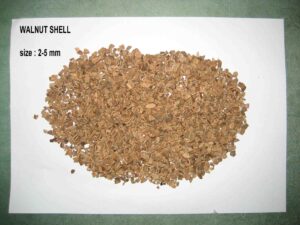
What Is Walnut Shell?
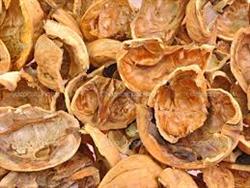
Walnut shell is the hard outer shell surrounding the walnut kernel.
After the edible kernel is removed, the shell can be collected and processed instead of being discarded.
Industrial processing generally involves:
- Collection
- Cleaning
- Drying
- Crushing
- Grinding
- Screening
- Particle-size classification
- Packaging
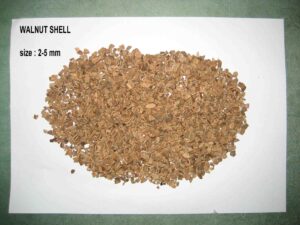
The resulting product can be supplied as crushed walnut shell, walnut shell granules, or walnut shell powder.
Why Is Walnut Shell Used Industrially?
Walnut shell has several characteristics that make it useful as an industrial material.
These include:
- Natural origin
- Relatively low density
- Hardness
- Abrasive properties
- Reusable characteristics in selected applications
- Biodegradability
- Low silica content compared with many mineral abrasives
- Availability as an agricultural by-product
- Ability to be processed into different particle sizes
The importance of each characteristic depends on the application.
Walnut Shell Properties
Hardness
Walnut shell has sufficient hardness to function as a mild to medium abrasive in various cleaning and surface-treatment applications.
Its abrasive behavior depends on:
- Shell source
- Particle size
- Moisture
- Processing
- Shape
- Hardness
Low Density
Walnut shell is lighter than many conventional mineral abrasives.
This can be advantageous in applications where a lower-density abrasive or filler is required.
Natural and Biodegradable Material
Walnut shell is derived from a renewable agricultural resource.
Its natural origin makes it attractive for applications where users want to reduce dependence on some synthetic or mineral abrasive materials.
Low Silica Characteristics
Walnut shell is an organic material and does not have the same crystalline silica characteristics as many mineral abrasives.
However, occupational dust controls are still necessary when handling or processing finely ground walnut shell.
Absorption
Walnut shell can absorb certain liquids and is used in selected filtration and industrial applications.
Its absorption characteristics depend on particle size and processing.
Walnut Shell Particle Sizes
Particle size is one of the most important commercial specifications.
Walnut shell can be supplied in:
- Coarse granules
- Medium granules
- Fine granules
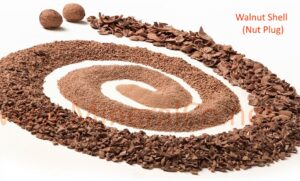
- Powder
- Micronized or very fine material
- Customized particle-size distributions
Different industries require different sizes.
For example:
- Coarse particles may be used for certain blasting applications.
- Medium particles can be used in cleaning and filtration.
- Fine powder may be used in specialized industrial formulations.
Buyers should specify the required mesh size or particle-size distribution.
Walnut Shell Powder
Walnut shell powder is produced by grinding and screening walnut shells into a fine particle-size range.
It can be used in:
- Abrasive products
- Polishing
- Filtration
- Oil and gas applications
- Composite materials
- Industrial fillers
- Cleaning products
The required mesh should always be specified because “walnut shell powder” can refer to a wide range of particle sizes.
Walnut Shell as an Abrasive
One of the best-known industrial uses of walnut shell is as an abrasive blasting and cleaning material.
Walnut shell abrasive is softer than many mineral abrasives, making it useful where aggressive removal of the underlying surface should be minimized.
Potential applications include:
- Cleaning
- Polishing
- Surface preparation
- Paint removal
- Coating removal
- Removal of carbon deposits
- Cleaning of delicate surfaces
- Industrial equipment cleaning
The correct particle size should be selected according to the surface and cleaning requirement.
Walnut Shell for Blasting and Cleaning
Walnut shell can be used as a blasting medium for selected cleaning operations.
Its relatively mild abrasive action can help remove unwanted materials while reducing the risk of damaging certain surfaces compared with harder abrasive media.
Potential applications include:
- Engine-component cleaning
- Industrial machinery
- Turbine components
- Electrical equipment
- Mold cleaning
- Aerospace-related component cleaning
- Automotive components
- Delicate metal surfaces
The appropriate grade depends on the substrate and contaminant.
Walnut Shell in Oil and Gas Drilling
Walnut shell is used in certain oil and gas drilling-fluid applications.
Ground walnut shell can function as a lost-circulation material (LCM) in selected drilling conditions.
Walnut Shell as Lost Circulation Material
Lost circulation occurs when drilling fluid escapes into fractures, vugs, or highly permeable formations.
Walnut shell particles can be used as part of a lost-circulation treatment because different particle sizes can help bridge or partially seal openings in the formation.
Depending on the application, walnut shell may be supplied in:
- Fine grades
- Medium grades
- Coarse grades
- Blended particle-size distributions
The appropriate size and concentration depend on the formation and drilling-fluid system.
Walnut Shell for Filtration
Walnut shell can be used in certain filtration applications.
Ground walnut shell media may be used for removing selected contaminants from liquids or industrial streams.
Potential applications include:
- Water treatment
- Oil filtration
- Industrial wastewater
- Produced-water treatment
- Petroleum-related filtration
The required particle size and treatment characteristics depend on the filtration system.
Walnut Shell for Produced Water Treatment
In some oil and gas applications, walnut shell media can be used in filtration systems designed to remove oil and suspended solids from produced water.
Its suitability depends on:
- Filter design
- Particle size
- Flow rate
- Contaminant concentration
- Required filtration efficiency
The filtration system should be designed and tested according to the specific operating conditions.
Walnut Shell in Polishing
Walnut shell can be used as a polishing medium because it provides a relatively gentle abrasive action.
Applications may include:
- Jewelry polishing
- Metal polishing
- Wood finishing
- Plastic components
- Decorative materials
The correct particle size and hardness should be selected according to the material being polished.
Walnut Shell in Cosmetics and Personal Care
Very finely processed walnut shell has historically been used in some exfoliating products.
However, suitability for cosmetic or personal-care applications depends on particle shape, safety requirements, regulations, and product formulation.
Industrial walnut shell should not automatically be considered suitable for cosmetic use.
Walnut Shell in Composite Materials
Ground walnut shell can be incorporated into certain composite materials as a natural filler.
Potential benefits include:
- Renewable raw material
- Low density
- Natural appearance
- Potential cost advantages
- Utilization of agricultural waste
The performance depends on particle size, treatment, resin system, and formulation.
Walnut Shell in Foundry Applications
Walnut shell can be used in selected foundry-related applications, including certain additives and carbonaceous materials.
The suitability depends on the foundry process and required formulation.
Technical testing should be carried out before commercial-scale use.
Walnut Shell for Surface Preparation
Walnut shell can be used for surface preparation where a less aggressive abrasive is required.
Compared with harder abrasive materials, walnut shell can be useful when the goal is to remove contaminants while minimizing substrate damage.
Possible applications include:
- Coating preparation
- Cleaning
- Deburring
- Polishing
- Restoration
Iranian Walnut Shell
Iran has a significant walnut-growing industry, providing access to walnut shells as an agricultural by-product.
The characteristics of Iranian walnut shell depend on:
- Walnut variety
- Agricultural source
- Shell thickness
- Processing method
- Cleaning
- Drying
- Grinding
- Screening
For export applications, consistent processing and particle-size classification are particularly important.
Iranian Walnut Shell for Export
Processed Iranian walnut shell can be supplied to international buyers for applications including:
- Oil and gas drilling
- Lost circulation materials
- Filtration
- Abrasive blasting
- Industrial cleaning
- Polishing
- Composite materials
- Industrial fillers
Export products should be supplied according to a clearly defined particle-size and quality specification.
Walnut Shell Quality Requirements
Important quality parameters may include:
- Particle-size distribution
- Moisture content
- Foreign matter
- Dust content
- Hardness
- Bulk density
- Cleanliness
- Organic purity
- Color
- Packaging condition
The relative importance of each parameter depends on the application.
Walnut Shell Technical Specifications
A commercial specification sheet may include:
| Parameter | Specification |
| Material | Crushed / ground walnut shell |
| Origin | Iran |
| Appearance | Natural brown shell particles |
| Moisture | Grade dependent |
| Particle Size | Customer specified |
| Bulk Density | Grade dependent |
| Foreign Matter | Controlled |
| Dust Content | Grade dependent |
| Hardness | Natural walnut shell |
| Packaging | Bags or jumbo bags |
| Application | Drilling, filtration, abrasive and other industrial uses |
Actual values should be confirmed by laboratory testing and the supplier’s technical data sheet.
Walnut Shell Mesh Sizes
Mesh size is an important commercial parameter.
Buyers should specify whether they require:
- Coarse grade
- Medium grade
- Fine grade
- Powder
- A specific mesh range
- A customized particle-size distribution
For oil and gas applications, buyers may also specify the required particle-size distribution rather than a single mesh size.
Walnut Shell Moisture
Moisture content can affect:
- Storage stability
- Flowability
- Grinding
- Screening
- Packaging
- Performance in certain industrial applications
Proper drying and moisture control are therefore important during processing.
Walnut Shell Cleaning and Processing
A professional processing operation should remove unwanted materials before final packaging.
Processing may include:
- Separation from residual kernel
- Removal of foreign materials
- Washing or cleaning when required
- Drying
- Crushing
- Grinding
- Screening
- Magnetic or other separation where appropriate
- Final quality inspection
- Packaging
The exact process depends on the final application.
Walnut Shell Packaging
Walnut shell can be supplied in different packaging formats.
Common options include:
- 20–25 kg bags
- 25 kg bags
- 40 kg bags
- 50 kg bags
- Jumbo bags
- Customized industrial packaging
Packaging should protect the material from excessive moisture and contamination.
Walnut Shell Storage
Walnut shell should be stored in a clean and dry warehouse.
Recommended practices include:
- Protect from rain and moisture
- Keep bags sealed
- Avoid contamination
- Maintain dry storage conditions
- Use suitable ventilation
- Follow appropriate dust-control measures
Fine walnut shell powder can generate dust during handling, so appropriate workplace controls should be implemented.
Walnut Shell Safety and Handling
Although walnut shell is a natural material, industrial handling of fine particles should be carried out responsibly.
Good practices include:
- Avoid unnecessary dust generation
- Use suitable ventilation
- Use appropriate personal protective equipment
- Follow the applicable Safety Data Sheet
- Maintain clean working areas
- Store material appropriately
For applications involving human exposure, such as cosmetics or food-related processes, additional regulatory and safety requirements apply.
Walnut Shell Price
There is no single international price for walnut shell.
Pricing depends on:
- Particle size
- Quality
- Moisture
- Processing
- Cleaning
- Packaging
- Order quantity
- Origin
- Destination
- Freight
- Application-specific requirements
Fine and highly classified products may have a higher processing cost than unprocessed shell.
For an accurate quotation, buyers should provide the required mesh size, quantity, packaging, and destination.
How to Buy Walnut Shell from Iran
International buyers should provide the following information when requesting a quotation:
- Intended application
- Required particle size
- Required mesh
- Quantity
- Moisture requirement
- Packaging
- Destination
- Preferred Incoterm
- Required documents
- Inspection requirements
The supplier can then provide a technical specification, sample, quotation, packaging details, and shipping information.
How to Choose the Right Walnut Shell Grade
The correct grade depends primarily on the application.
For abrasive blasting, consider:
- Particle size
- Hardness
- Surface condition
- Required cleaning intensity
For drilling applications, consider:
- Particle-size distribution
- Formation characteristics
- Drilling-fluid compatibility
- Lost-circulation requirements
For filtration, consider:
- Particle size
- Filter-bed design
- Flow rate
- Contaminant type
- Required filtration performance
Walnut Shell vs Mineral Abrasives
Walnut shell differs from many mineral abrasives in several important ways.
| Characteristic | Walnut Shell | Mineral Abrasives |
| Origin | Agricultural | Mineral |
| Density | Relatively low | Usually higher |
| Abrasive Action | Relatively mild | Can be aggressive |
| Silica Characteristics | Organic material | Depends on mineral |
| Biodegradability | Natural biodegradable material | Generally mineral |
| Particle Sizes | Various | Various |
| Applications | Cleaning, polishing, drilling, filtration | Blasting and industrial applications |
The best abrasive depends on the surface, contaminant, equipment, and required cleaning performance.
Walnut Shell for Environmental Applications
The use of walnut shell can help convert an agricultural by-product into a value-added industrial material.
Instead of treating walnut shells solely as agricultural waste, processing them into industrial grades can create additional value through applications such as:
- Filtration
- Abrasives
- Drilling additives
- Composite fillers
- Polishing media
The environmental benefits depend on processing, transportation, energy consumption, and the specific alternative material being replaced.
Frequently Asked Questions
What is walnut shell used for?
Walnut shell is used in abrasive blasting, industrial cleaning, polishing, oil and gas drilling, filtration, lost-circulation materials, composite materials, and selected industrial applications.
What is walnut shell powder?
Walnut shell powder is finely ground walnut shell classified according to particle size or mesh.
Is walnut shell used in oil and gas drilling?
Yes. Ground walnut shell can be used in selected drilling-fluid applications, particularly as a lost-circulation material.
What is walnut shell used for in drilling?
Walnut shell can help bridge or partially seal fractures and loss zones in certain drilling conditions.
Can walnut shell be used as an abrasive?
Yes. Walnut shell is a relatively mild natural abrasive used for cleaning, polishing, blasting, and surface treatment.
Is walnut shell suitable for delicate surfaces?
Its relatively mild abrasive action can make it suitable for some surfaces where a more aggressive abrasive could cause damage. The correct grade should always be tested first.
What particle sizes are available?
Walnut shell can be supplied as coarse granules, medium grades, fine grades, and powder, with customized particle sizes available depending on the supplier.
Is Iranian walnut shell available for export?
Processed walnut shell from Iran can be supplied to international industrial buyers depending on product availability, specifications, quantity, and destination requirements.
How is walnut shell packaged?
Common packaging includes standard bags, larger bags, and jumbo bags. Customized packaging may also be possible.
How can I request a walnut shell quotation?
Provide the intended application, particle size or mesh, quantity, packaging, destination, and any technical requirements.
Related Walnut Shell Articles
The following supporting articles should be developed around this Pillar Page:
- What Is Walnut Shell?
- Walnut Shell Powder Uses
- Walnut Shell Abrasive
- Walnut Shell Blasting Media
- Walnut Shell for Industrial Cleaning
- Walnut Shell for Polishing
- Walnut Shell for Oil and Gas Drilling
- Walnut Shell as Lost Circulation Material
- Walnut Shell for Filtration
- Walnut Shell for Produced Water Treatment
- Walnut Shell Particle Size and Mesh
- Walnut Shell Bulk Density
- Walnut Shell Moisture Content
- How Walnut Shell Is Processed
- Walnut Shell vs Mineral Abrasives
- Walnut Shell for Surface Preparation
- Walnut Shell for Composite Materials
- Iranian Walnut Shell Suppliers
- Walnut Shell Export from Iran
- How to Buy Walnut Shell from Iran
- Walnut Shell Price Factors
- Walnut Shell Packaging and Shipping
Conclusion
Walnut shell is a useful natural industrial material that can transform an agricultural by-product into a range of value-added products.
Its combination of relatively low density, abrasive characteristics, natural origin, and flexible particle-size classification makes it suitable for applications in industrial cleaning, polishing, blasting, oil and gas drilling, filtration, and other specialized industries.
Iran’s walnut production provides a source of raw material for processed walnut shell products. For export markets, however, consistent cleaning, drying, grinding, screening, quality control, and packaging are essential.
International buyers should specify the intended application, particle size, moisture requirement, quantity, packaging, and destination when requesting a quotation.
Request a Walnut Shell Quotation
For Iranian walnut shell specifications, particle sizes, samples, availability, bulk quantities, packaging, and export quotations, contact us with your intended application, required mesh size, quantity, destination, and preferred delivery terms. Please Contact with info@iranbentonite.net .